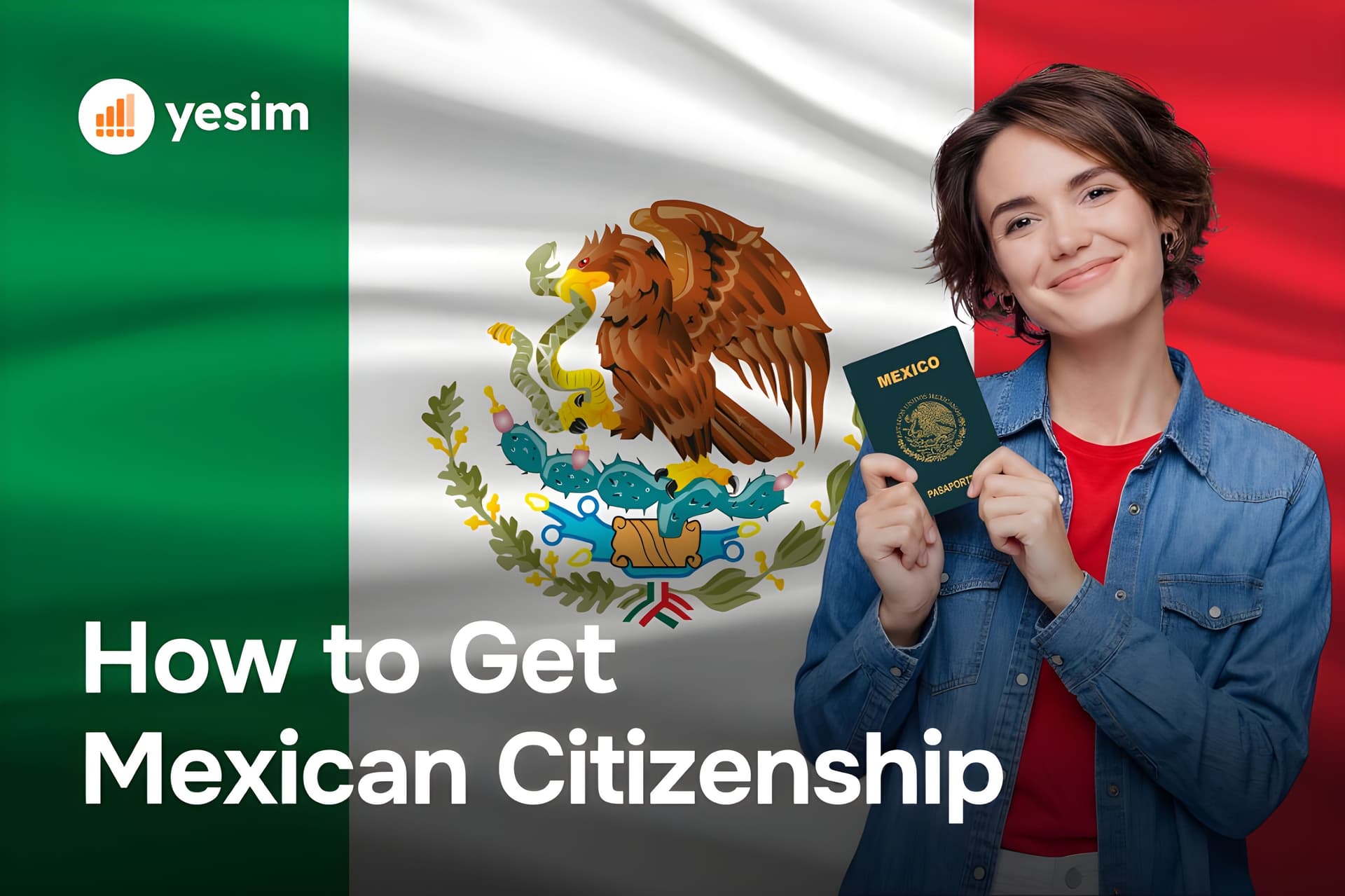
How to Get Citizenship in Mexico: Dual Citizenship, Requirements, and Timeline in 2026

Table of contents

- Ways to Get Citizenship in Mexico
- How to Get Citizenship in Mexico Through Parents?
- How to Get Dual Citizenship in Mexico by Marriage?
- How to Get Citizenship in Mexico as a US Citizen?
- Does Mexico Allow Dual Citizenship?
- Naturalization Process for Mexican Citizenship
- How Hard Is It to Get Citizenship in Mexico?
- How Much Does It Cost to Get Dual Citizenship in Mexico?
- Documents Required for Mexican Citizenship
- Mexican Passport Benefits
Share
Share
Yesim virtual SIM card for travelers
Get a 10% discount for your first purchase with the code
Many foreigners start researching how to get citizenship in Mexico when Mexico becomes a place for long-term living rather than a short visit. As interest grows, people naturally wonder how hard is it to get citizenship in Mexico, especially if they have never dealt with Mexican legal procedures before. The topic of dual citizenship in Mexico is often central, because most applicants want to keep their original nationality.
This question is especially relevant for Americans exploring how to get citizenship in Mexico as a US citizen while maintaining legal ties to the United States. A clear understanding of Mexican citizenship requirements allows applicants to assess their options realistically before starting the process.
Does Mexico Allow Dual Citizenship?

Many foreigners want clarity on whether Mexico allow dual citizenship when planning long-term residency or legal integration. So, how to get your citizenship in Mexico? Mexican law confirms that the country allows dual nationality, meaning applicants are not required to give up their original status. This is especially relevant for people holding US citizenship, since Mexico does not demand renunciation during the application process.
From a legal perspective, dual nationality is fully recognized, but individuals are treated as Mexican citizens while inside the country. Certain legal nuances apply to those who hold dual nationality , particularly in areas such as voting rights and access to government positions. These conditions are established under the Mexican constitution, which prioritizes national obligations within Mexican territory. Official explanations published by the official Mexican government clarify that dual citizenship is lawful but comes with clearly defined boundaries.
🇲🇽 Read also: Top Places to Visit in Mexico
Ways to Get Citizenship in Mexico
There are several legal paths to obtain citizenship in Mexico, and each option depends on a person’s origin, family ties, or length of residence. Mexican law clearly defines who may qualify, making it important to understand which category applies before starting the application. How to get your dual citizenship in Mexico? The main ways to acquire Mexican citizenship include:
- Born in Mexico, which grants nationality automatically under birthright rules
- Citizenship by descent, when a person has at least one Mexican parent
- Married to a Mexican citizen, provided the marriage is legally registered and residency conditions are met mexican naturalization, available to foreigners who meet residence and integration requirements
- Citizenship in Mexico for foreigners, which includes specific provisions for U.S. nationals and long-term residents
Each route follows a different citizenship process, with its own documentation, timelines, and legal checks. Some applicants must first establish legal residency in Mexico, while others may apply directly based on family status. Choosing the correct path early reduces delays and helps applicants avoid applying under the wrong legal category.
How to Get Citizenship in Mexico Through Parents?
Mexican law grants nationality by origin to individuals whose Mexican parent was a citizen at the time of birth, even if the child was born abroad to a Mexican. This right is established in the Mexican nationality law, which recognizes citizenship by bloodline rather than place of birth. Applicants in this category are considered Mexican from birth and are not subject to residence or integration requirements.
To claim citizenship, the applicant must submit a defined set of documents to the authorities. The standard list of documents for Mexican citizenship includes:
- the applicant’s birth certificate, legalized or apostilled
- the parent’s Mexican birth certificate or proof of nationality
- official identification of the Mexican parent
- a completed registration form issued by the secretaría de relaciones exteriores
Applications may be filed through the nearest Mexican consulate, and processing typically takes 4 to 8 weeks, depending on document verification. Importantly, residency in Mexico is not required, and applicants may complete the entire process while living abroad.
✴️ Read also: Roaming in Mexico for Tourists: Best Mobile Plans, SIM & eSIM Options
How to Get Dual Citizenship in Mexico by Marriage?
Marriage provides a legal route for applicants researching how to get dual citizenship in Mexico by marriage, but this path has clearly defined conditions. To qualify, the applicant must be married to a Mexican national in a marriage legally registered with Mexican civil authorities. The relationship must be genuine, as marriages of convenience are screened out during review, and applicants must be married to a Mexican at the time of filing.
Mexican law sets a reduced residence requirement for spouses, and under Mexican nationality law, the applicant must legally reside in Mexico for at least two consecutive years before applying. During this period, the applicant must stay in Mexico under valid immigration status and maintain continuous Mexican residency, meaning extended absences can restart the timeline. The application process includes strict document checks, and applicants must submit:
- a valid marriage certificate issued or recognized in Mexico
- proof of legal residence covering the full two-year period
- identification documents and immigration records
- evidence that the marriage remains active
Common errors include assuming automatic approval for dual citizens, submitting incomplete files, or misunderstanding residence rules, which often leads to delays or rejection when authorities apply for citizenship review.
How to Get Citizenship in Mexico as a US Citizen?
For applicants researching how to get citizenship in Mexico as an American, Mexico does not apply separate nationality rules for U.S. citizens, but practical differences still exist.
The legal basis remains Mexico citizenship for foreigners, meaning eligibility depends on residence, marriage, or descent rather than U.S. nationality. Many Americans specifically explore how to get dual citizenship in US and Mexico, and Mexican law fully permits this status. The same outcome applies when examining how to get dual citizenship in Mexico and us, as neither country requires renunciation of citizenship.
📳 Read also: Best eSIM for Mexico
Dual Citizenship US–Mexico and Legal Status
Holding dual citizenship with Mexico allows a person to be treated as Mexican while inside the country, while still retaining full U.S. nationality abroad. This framework reflects long-standing legal coordination between the US and Mexico, but it does not unify legal obligations. Within Mexico, dual nationals are subject to Mexican civil law and cannot claim U.S. consular protection in domestic matters. This principle applies equally when living between Mexico and the US.
Taxes and Financial Obligations
How to get a dual citizenship in Mexico? Citizenship does not replace tax responsibility. The United States taxes its citizens on worldwide income, with federal income tax rates ranging from 10% to 37% depending on income level. Mexico taxes residents based on fiscal residency, with progressive income tax rates up to 35% for high earners. Tax residency is usually triggered by spending more than 183 days per year in Mexico. While tax treaties help avoid double taxation, Americans must still file U.S. tax returns annually regardless of where they live.
Where and How to Apply?
Applicants may file through a local Mexican consulate in the United States or directly at an office in Mexico City if already residing in Mexico. Proper coordination between immigration status, tax residency, and long-term planning is essential to avoid compliance issues.
Naturalization Process for Mexican Citizenship

Naturalization is the standard route for foreigners who want to become a naturalized Mexican citizen without Mexican parents or a Mexican spouse. Under federal rules, the minimum residency before citizenship Mexico is five consecutive years of legal residence, although this period may be reduced in specific cases defined by law. To qualify, applicants must hold valid Mexican residency, which proves continuous and lawful stay in the country.

Eligible Residence Types
Not every immigration status qualifies, and only certain permits allow a person to become a naturalized citizen. The accepted residence categories include:
- Temporary Resident status held continuously for the required period
- Permanent Resident status obtained through long-term residence or family ties
These permits form the legal basis of the Mexican citizenship application process, and gaps in residence can restart the timeline.
Language and Knowledge Exams
Applicants must pass mandatory exams covering language and civic knowledge as part of naturalization in Mexico procedures.The test includes basic Spanish proficiency and questions on Mexican history, national institutions, and Mexican culture, and it is administered by federal authorities.
Applicants who pass all stages are officially recognized as a naturalized citizen of Mexico, after taking an oath and completing final registration steps outlined in the Mexican citizenship timeline.
How Hard Is It to Get Citizenship in Mexico?
Many applicants evaluate the process by asking how hard is it to get dual citizenship in mexico, and the realistic answer depends on preparation rather than nationality. From a legal standpoint, Mexican procedures are standardized and transparent, but the system is document-heavy and strictly regulated by citizenship laws. The most demanding part is not eligibility itself, but proving uninterrupted legal status and compliance over several years.
Bureaucracy plays a central role, and delays usually occur during document verification and background checks. Although penalties related to holding more than one nationality are rarely enforced for dual citizens, authorities closely review residence records and application history. Applicants who attempt citizenship without meeting formal residence or documentation rules typically face rejection or long postponements. On average, complete review and approval can take 6 to 12 months after submission, assuming the file is complete and accurate.
How to get my dual citizenship in Mexico? When compared internationally, Mexico is considered moderately accessible. Countries like Germany often require 8 years of residence, while Spain generally requires 10 years for most applicants. In contrast, Mexico allows dual or multiple nationalities and sets a standard 5-year residence requirement for naturalization, making it more flexible than many European systems. The process is demanding, but with proper planning and accurate documentation, it remains achievable for most applicants.
How Long Does It Take to Get Dual Citizenship in Mexico?
Many applicants begin by researching how long to get dual citizenship in Mexico, because timelines differ significantly depending on the legal basis. The fastest cases involve people eligible through Mexican nationality by birth, since this status exists automatically and only requires formal registration. Applicants whose parents are Mexican citizens usually complete recognition within 4 to 8 weeks, provided all documents are correct.
Those applying through marriage must legally reside in Mexico for at least two consecutive years before filing, after which the review stage typically takes 6 to 12 months. Naturalization is the longest route, as foreigners must live in Mexico for five years before they can submit your application, followed by an additional 6 to 12 months of processing.
Average timelines by pathway
The overall Mexican citizenship timeline can be summarized as follows:
- Citizenship by descent or birthright citizenship: 1–2 months after submission
- Marriage-based applications: 2 years of residence + 6–12 months review
- Naturalization: 5 years of residence + up to 12 months processing
Complex cases involving prior gaps may take longer and require applicants to return to Mexico to reestablish continuity Processing time is influenced by document quality, background checks, and compliance with Mexican law.
Applications submitted through official channels such as the Mexican government website are generally processed faster than incomplete filings. Applicants applying from outside of Mexico through a Mexican consulate may experience longer verification periods, especially if foreign documents require legalization.
Common causes of delays
Delays often occur when applicants apply to Mexico without uninterrupted legal status, submit insufficient proof of Mexican ties, or misunderstand residence requirements. In such cases, authorities may pause the dual citizenship application until corrections are made.
How Much Does It Cost to Get Dual Citizenship in Mexico?
Applicants often ask how much is it to get dual citizenship in Mexico, because costs depend on the legal route and the number of documents involved. The core expense is the government filing fee, which is paid in Mexican pesos and set annually by federal authorities.
As of recent schedules, the standard naturalization fee ranges from $8,000 to $9,500 MXN, while registration through descent is significantly lower. All payments are regulated by the Mexican government and must be made through official channels.
Government fees and official charges
Mandatory costs may include:
- Naturalization filing fee required to apply for Mexican citizenship;
- Registration and issuance fees to obtain Mexican citizenship;
- Additional charges when applying through offices in Mexico City or federal centers.
Applicants with foreign documents must budget for certified translations and apostilles. These costs vary by country, but legalization of a single document typically ranges from $20 to $100 USD. Proof files such as proof of Mexican nationality or civil records must be properly legalized to be accepted by de relaciones exteriores.
Legal assistance and optional costs
Hiring a lawyer is not mandatory, but professional help may simplify complex cases involving prior residence gaps or assets like property in Mexico or a house in Mexico. Legal services usually cost between $1,000 and $3,000 USD, depending on case complexity. While optional, legal guidance can help applicants acquire Mexican citizenship efficiently and avoid costly mistakes.
Documents Required for Mexican Citizenship

Understanding the required paperwork is essential for anyone researching how to get a citizenship in Mexico, because document errors are the most common reason for delays. Regardless of the legal basis, every citizenship application is reviewed under federal standards that define nationality in Mexico and confirm whether an applicant can be recognized as a mexican citizen. The exact list may vary, but the core requirements remain consistent for most applicants seeking mexican citizenship.
Main document checklist
Applicants must prepare a complete file before authorities will review the case. The standard documents used to obtain Mexican nationality include:
- a valid passport and immigration record
- civil status records proving identity and family ties
- evidence showing eligibility to acquire Mexican nationality
- documents confirming whether the applicant qualifies as a Mexican child, including cases involving a Mexican mother or children of a Mexican father
These records are used to determine if the applicant can become a Mexican citizen under the applicable legal category.
Translations and legalization
All foreign documents must be translated into Spanish and legalized before submission. Applications filed from outside Mexico often require apostilles, while local filings rely on validation by official Mexican authorities. Failure to complete this step prevents officials from formally reviewing the case or allowing the applicant to get Mexican nationality.
Common reasons for refusal
Most rejections occur when applicants misunderstand dual nationality means, submit incomplete files, or fail to prove lawful status. Applications may also be denied if applicants cannot demonstrate eligibility to gain Mexican citizenship or misunderstand the rules for double citizenship, including the requirement to swear loyalty to the Mexican state during final approval.
Mexican Passport Benefits
A Mexican passport provides visa-free or visa-on-arrival access to 150+ countries, including the Schengen Area, the UK, Japan, and most of Latin America, which explains sustained interest in Mexican passport benefits. Citizenship also allows a person to live in mexico without residence renewals, work permits, or immigration limits.
A citizen who is considered a Mexican gains unrestricted employment rights, access to public healthcare systems, and full property ownership. This status is particularly attractive for those planning to retire in Mexico, as it removes long-term stay uncertainty. Holding dual citizenship gives flexibility, since a dual national can maintain legal ties to another country while enjoying local rights. In practice, the benefits of dual citizenship include inheritance security, simplified family sponsorship, and long-term legal stability.
Common Mistakes When Applying for Mexican Citizenship
Most problems arise not from misunderstanding Mexican nationality, but from avoidable procedural errors. Applicants often believe they already know how to get Mexican citizenship in Mexico, yet overlook formal requirements that directly affect approval. The most common mistakes include:
- Applying under the wrong legal basis when trying to get dual citizenship, especially without meeting residence rules set by Mexico dual nationality rules
- Insufficient proof of residence, as applicants must show physical presence in Mexico for Mexico for at least the legally required period without undocumented absences
- Incorrect or incomplete documentation in cases involving Mexican nationality by descent citizenship, which frequently leads to requests for additional evidence
- Assuming automatic approval for dual citizenship without completing mandatory legal steps
- Ignoring final formalities related to becoming a dual citizen, including registration and legal declarations required before a case is closed
Careful preparation and document review significantly reduce delays and increase the likelihood of approval.
Conclusion
Mexico clearly confirms that can Mexico have dual citizenship is not a legal barrier under current law. The path depends on individual circumstances, whether through descent, marriage, or residence under mexican nationality rules.
People researching how to get my citizenship in Mexico benefit most from early preparation and accurate documentation. With proper planning, applicants can move efficiently toward obtaining Mexican nationality and long-term legal security.

Share
Share
FAQ
Can foreigners legally hold more than one nationality with Mexico?
Yes, Mexican law clearly allow dual citizenship, meaning foreigners are not required to renounce their original nationality. Once a person is granted Mexican citizenship, they are treated as Mexican inside the country, while still retaining rights abroad. This legal framework makes dual status practical for long-term residents and international families.
How does dual citizenship work for people applying from outside Mexico?
Many applicants explore how to get a dual citizenship in Mexico while living abroad. The process usually starts through a consulate, after which applicants apply for a Mexican passport once nationality is confirmed. Mexico recognizes citizenship granted abroad, but final registration is required before full rights apply domestically.
Is citizenship through parents faster than other options?
Yes, people researching how to get citizenship in mexico through parents often benefit from a faster process. When parentage is proven, authorities recognize nationality by descent rather than naturalization. This allows applicants to acquire Mexican nationality without residence requirements, making it one of the simplest and quickest legal paths available.
Can Mexican citizens later apply for U.S. citizenship as well?
Some applicants ask how to get citizenship in us from Mexico after becoming Mexican nationals. While Mexico permits dual status, U.S. citizenship follows a separate process based on residency and federal law. Holding Mexican nationality does not guarantee U.S. approval, but it does not prevent future eligibility either.
Does location matter when applying for dual citizenship in Mexico?
Location can influence logistics but not eligibility. People researching how to get dual citizenship for Mexico in Chicago often apply through consulates, while others file inside Mexico. In both cases, once approved, applicants are granted Mexican citizenship under the same national standards and legal protections.
Recommended eSIMs

Pay & Fly
Unlimited data. Pay as you go
South America eSIM
12 countries
Caribbean eSIM
14 countries

Aruba eSIM
from $15.60 / day
Dominican Republic eSIM
from $6.80 / day

Jamaica eSIM
from $3.36 / day
Puerto Rico eSIM
from $2.20 / day
Turks & Caicos Islands eSIM
from $7.12 / day
Bermuda eSIM
from $6.60 / GB
Bahamas eSIM
from $6.80 / day

Saint Lucia eSIM
from $6.32 / day

Brazil eSIM
from $2.60 / day

Argentina eSIM
from $2.60 / day